Rehab and surgical techniques after an (anterior) cruciate ligament injury have developed and improved significantly in recent years. Yet re-injury rates and the share of people who don't return to…
The rehabilitation process and surgical techniques after an (anterior) cruciate ligament injury have developed and improved considerably in recent years. Even so, the re-injury rates and the proportion of people who do not return to their previous level (especially among young athletes) are still too high and not acceptable [1,2,3,4]. Building on these findings, a good rehab process with a well-planned long-term structure and a detailed, meaningful RTS test battery at the end is extremely valuable for bringing athletes back to a high-performing, stable level in the best possible way.
Today, new aspects such as psychological readiness or fear of movement, whether in general or in relation to practising one's individual sport or competing, are becoming increasingly important and more highly valued [5,6]. This adds further nuances to the pure strength and mobility tests of older RTS batteries and continues to change the course of rehabilitation. Additional aspects such as the social environment and other environmental factors have also become more important. However, these can hardly be influenced directly in the therapy process. For this reason, they are not discussed further in this article.
In addition to these developments, the question of the time until returning to sport is being discussed more critically, and at the same time a highly sport-specific preparation is seen as increasingly important [8,9,12]. Such specific preparation often takes quite some time and therefore, unfortunately, usually exceeds the time and logistical framework of a typical rehab process in physiotherapy (in-house rehab). Yet regaining full confidence on the pitch is a decisive factor, especially for athletes who want to fully resume their sport. Aspects that could play a role in a sport-specific context include the footwear used, the playing surface, possible contact with an opponent as a disruptive factor in a movement, fatigue and general distraction from external factors, as well as any additional objects that have to be moved. Testing and practising these situations is often not possible in physiotherapy alone, and athletes are frequently just given independent exercises to do at home for such tasks. But further supervision and support in exactly this phase, when more variability and dynamics are supposed to come back in, can be very important for many athletes, not least so that they feel safe and prepared.
A paper by Gokeler et al. [7] takes a closer look at the overall situation of RTS. In it, the authors present 10 points that could be particularly relevant for a successful return to sport with a low risk of re-injury. Points mentioned here include an individually tailored operation, rehab with sensory and cognitive challenges and, of course, sport-specific loads.
However, most current test batteries and rehab processes in the RTS context fall short precisely on these latter factors and may therefore not fully reflect the complex loads and demands, e.g. reacting to unpredictable actions. As a result, athletes may not be prepared for their return to sport in the best possible way, which may be one reason for the higher re-injury rates. This is exactly where so-called On-Field Rehabilitation (OFR) can come into play and close this important gap in the recovery process.
What is On-Field Rehabilitation?
Put simply, OFR is training that closes precisely the gap between physio (indoor) and full-intensity team training (outdoor) [8,9]. Below, this concept is presented in a little more detail and explained with examples.
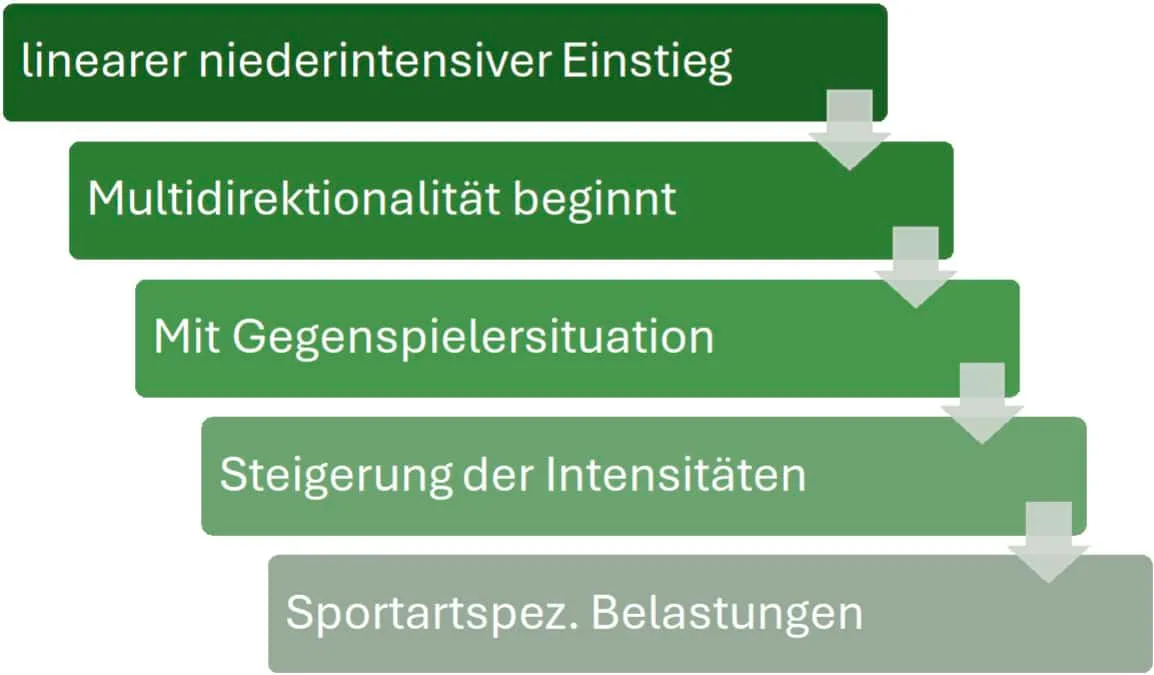
The idea of OFR was first described or mentioned by Della Villa [10] in 2012. In that study, OFR began with 50 footballers about 90 days post-op and led to improvements in the KOOS questionnaire, leg strength and endurance. The OFR process usually runs through 5 phases that prepare athletes for increasingly demanding and more typical situations (e.g. with opponent contact, reactive situations, etc.). These demands are both physical/mechanical and (neuro)cognitive in nature.
A major focus lies on planning and progressing variable demands/movement patterns and the load they place on the athletes [11].
However, an OFR programme of this kind already requires a good level of strength, movement quality and mobility, and the following criteria should be met beforehand so that OFR can be started:
- No knee pain and no swelling
- no subjective feeling of instability
- negative knee laxity test
- at least 80% strength symmetry (extension & flexion)
- good movement quality in basic movements
- sufficient endurance (approx. 10min at 8km/h).
The 5 phases of OFR
Using football, or the RTS leading up to it, as an example, the 5 phases of OFR are briefly outlined here (based on [9]).
Phase 1: is characterised by the start of linear movements on the pitch. The primary goal is to increase intensity (=movement speed) while movement quality (=execution) remains high. Initially this is done without a ball and without an opponent (higher variability/risk). These movements can also take place laterally and are performed, for the time being, at a speed chosen by the athlete themselves (shared decision).
Phase 2: is marked by the start of multidirectional movement patterns. Now the aim is, for example, to perform figure-8 runs or curved runs as well as more intense braking and acceleration movements. The patterns and exercises from Phase 1 can/should now be performed at almost maximum speed.
Phase 3: represents the next stage and is characterised above all by more sport-specific exercises and exercises with a reactive component (ball, partner). Previous tasks may now become more complex, and overall volumes should also increase in order to come closer to the workload of a full training session.
Phase 4: is the point at which almost full opponent contact (1:1 at approx. 85%) can be reintroduced, and the more complex multidirectional patterns are also practised at almost max. speeds. General loads, including in athletic training, should now be very intense and take place at relatively sport-specific full volumes (>5km total distance, sprint distances of approx. 300m in total, 20min of continuous load above 85% HRmax).
Phase 5: describes the final phase, in which, among other things, full training loads and volumes are reproduced and practised both with and without pre-fatigue. The goal here is to replicate normal training as closely as possible, with almost no restrictions/limitations regarding directions, intensities, opponent contact, etc.
*All phases are to be planned and progressed individually with the athletes.
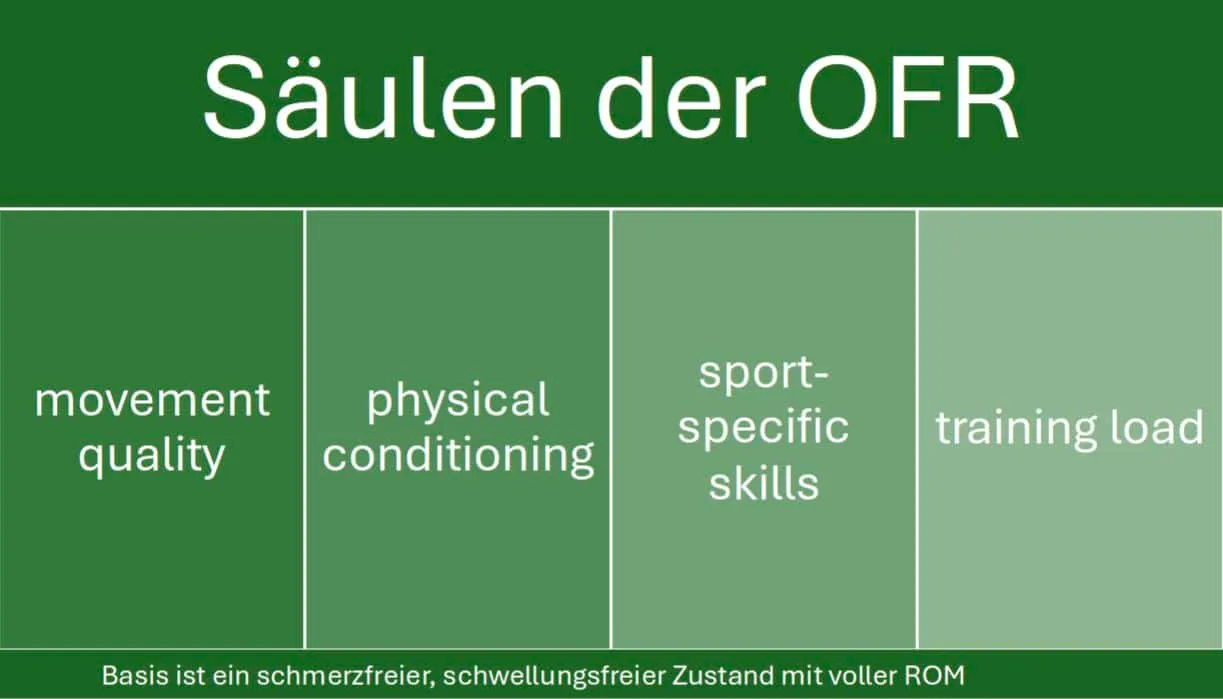
The 4 pillars of OFR
- Keeping movement quality stable (in unforeseen situations) (body position in space, knee angle/valgus, hip movement, etc.)
- Physical conditioning, both aerobic and anaerobic (the specific demands profile of the sport is important)
- Relearning sport-specific skills and technique (technical and tactical with more complex options, individually or in small groups, with and without pressure from opponents, reflection on what has been practised)
- Accumulating a typical training workload (volumes and intensities, keep an eye on the acute:chronic workload ratio)
These are decisive factors that determine further development in the later rehab or RTS process. To prepare athletes even better for competition with unpredictable situations, training here should, as mentioned above, involve gradually increasing uncertainty or increasingly uncertain situations.
In the specific example of football, cleanly executed braking movements [13,16] and changes of direction (CoD) [14] can and should be practised on the pitch at this stage in particular, as these are essential situations in which extremely high forces can act [11]. Mastering these loads well in terms of volume, intensity and technique is an essential and important foundation for preparing the final step, the return to competition (RTC).
A possible model for progressing these tasks was presented in 2022 [12].
Reproduction of Figure 2 from Gokeler
The final step: RTS test battery
However, the last step at the end of an RTS process is always a well-thought-out RTS test battery, complemented by the sensible use of questionnaires (KOOS, RSI or similar). Only once athletes have completed this process well, with their own sense of security and confidence, and the result of the final testing is satisfactory, should they fully return to sport-specific training and competition.
Sources
[1] Ardern CL, Taylor NF, Feller JA, Webster KE (2014) Fifty-five per cent return to competitive sport following anterior cruciate ligament reconstruction surgery: an updated systematic review and meta-analysis including aspects of physical functioning and contextual factors. Br J Sports Med 48:1543–1552
[2] Paterno MV, Rauh MJ, Schmitt LC, Ford KR, Hewett TE (2012) Incidence of Contralateral and Ipsilateral Anterior Cruciate Ligament (ACL) Injury After Primary ACL Reconstruction and Return to Sport. Clin J Sport Med 22:116–121
[3] Webster KE, Feller JA (2016) Exploring the High Reinjury Rate in Younger Patients Undergoing Anterior Cruciate Ligament Reconstruction. Am J Sport Med 44:2827–2832
[4] Webster KE, Hewett TE, Feller JA (2021) Anterior Cruciate Ligament Injuries in Australian Rules Football: Incidence, Prevention and Return to Play Outcomes. Open Access J Sport Med 12:33–41
[5] Ardern CL, Taylor NF, Feller JA, Whitehead TS, Webster KE (2013) Psychological responses matter in returning to preinjury level of sport after anterior cruciate ligament reconstruction surgery. Am J Sport Med 41:1549–1558
[6] Truong LK, Mosewich AD, Holt CJ, Le CY, Miciak M, Whittaker JL (2020) Psychological, social and contextual factors across recovery stages following a sport-related knee injury: a scoping review. Br J Sports Med 54:1149–1156
[7] Gokeler A, Grassi A, Hoogeslag R, et al. Return to sports after ACL injury 5 years from now: 10 things we must do [published correction appears in J Exp Orthop. 2022 Nov 17;9(1):111. doi: 10.1186/s40634-022-00548-x]. J Exp Orthop. 2022;9(1):73. Published 2022 Jul 30. doi:10.1186/s40634-022-00514-7
[8] Buckthorpe M, Della Villa F, Della Villa S, Roi GS (2019) On-field Rehabilitation Part 1: 4 Pillars of High-Quality On-field Rehabilitation Are Restoring Movement Quality, Physical Conditioning, Restoring Sport-Specific Skills, and Progressively Developing Chronic Training Load. J Orthop Sport Phys Ther 49:1–5
[9] Buckthorpe M, Della Villa F, Della Villa S, Roi GS (2019) On-field Rehabilitation Part 2: A 5-Stage Program for the Soccer Player Focused on Linear Movements, Multidirectional Movements, Soccer-Specific Skills, Soccer-Specific Movements, and Modified Practice. J Orthop Sport Phys Ther 49:1–6
[10] Della Villa S, Boldrini L, Ricci M, et al. Clinical Outcomes and Return-to-Sports Participation of 50 Soccer Players After Anterior Cruciate Ligament Reconstruction Through a Sport-Specific Rehabilitation Protocol. Sports Health. 2012;4(1):17-24. doi:10.1177/1941738111417564
[11] Vanrenterghem J, Venables E, Pataky T, Robinson MA. The effect of running speed on knee mechanical loading in females during side cutting. J Biomech. 2012;45:2444-2449. https://doi. org/10.1016/j.jbiomech.2012.06.029
[12] Gokeler A, McKeon PO, Hoch MC (2020) Shaping the Functional Task Environment in Sports Injury Rehabilitation: A Framework to Integrate Perceptual-Cognitive Training in Rehabilitation. Athl Train Sport Heal Care 12:283–292
[13] Blanch P, Gabbett TJ. Has the athlete trained enough to return to play safely? The acute:chronic workload ratio permits clinicians to quantify a player’s risk of subsequent injury. Br J Sports Med. 2016;50:471-475. https://doi. org/10.1136/bjsports-2015-095445
[14] Gabbett TJ. The training–injury prevention paradox: should athletes be training smarter and harder? Br J Sports Med. 2016;50:273-280. https://doi.org/10.1136/bjsports-2015-095788
[15] Buckthorpe M, Frizziero A, Roi GS. Br J Sports Med Epub ahead of print: doi:10.1136/bjsports-2018-099341
[16] McBurnie AJ, Harper DJ, Jones PA, Dos'Santos T. Deceleration Training in Team Sports: Another Potential 'Vaccine' for Sports-Related Injury?. Sports Med. 2022;52(1):1-12. doi:10.1007/s40279-021-01583-x