Background: many pregnant women are unsure how long they can keep exercising, or when they should or may start again. Is strength training or jumping dangerous during pregnancy? What happens to the pelvic floor during…
Background: Many pregnant women are unsure how long they may keep exercising, or when they should or may start again. Is it dangerous to do strength training or jumps during pregnancy? What happens to the pelvic floor during training, and how can/may I train it and my abdominal muscles again after pregnancy?
Overview: This post gives an overview of various international guidelines (including the USA, the UK, Denmark and Norway) and supplementary individual RCTs that aim to answer the questions above as well as possible. The goal is to paint a picture of the entire course of pregnancy and the period after birth with regard to women's general capacity for load and training.
What do the guidelines say?
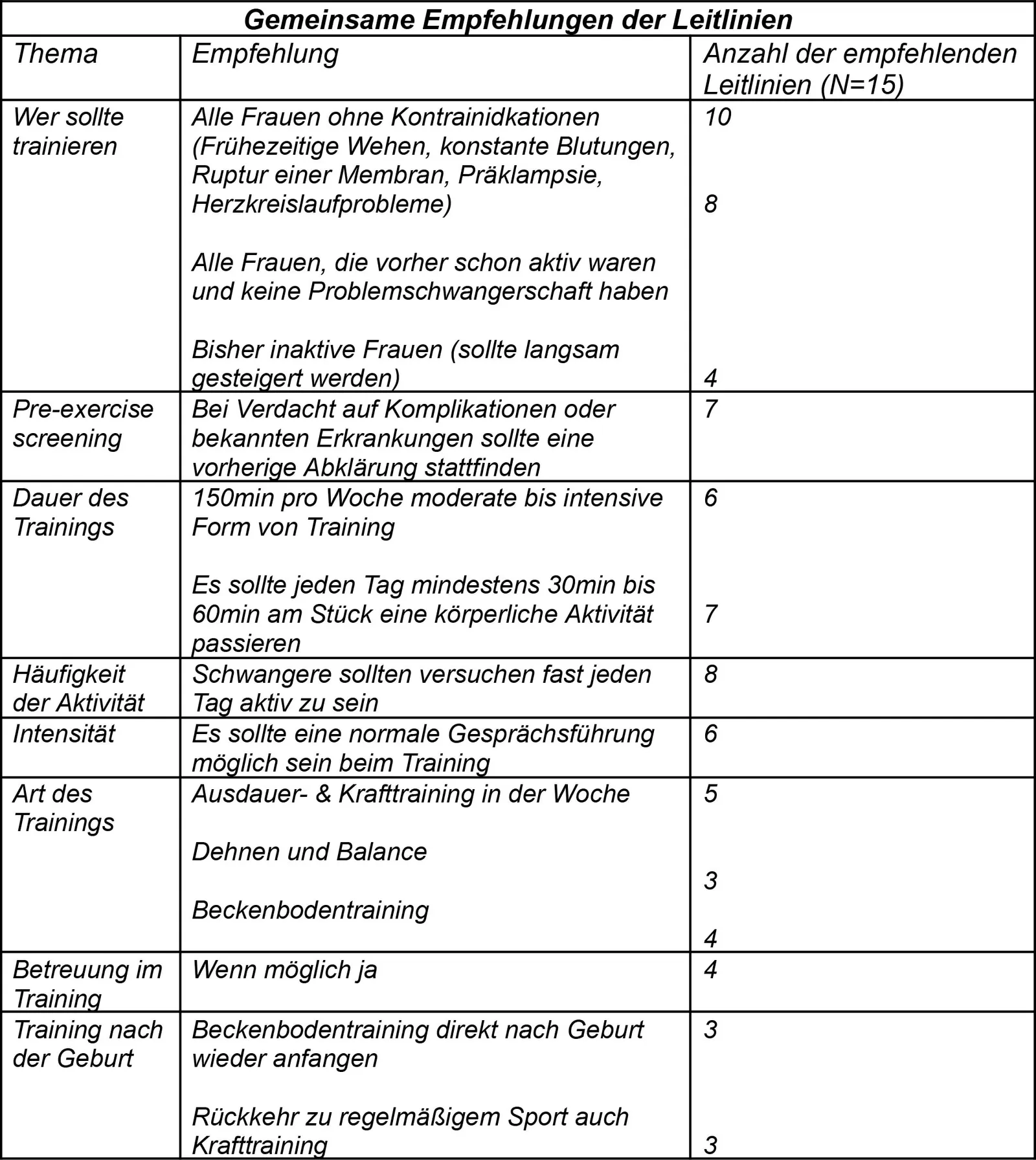
In the past, several studies showed that training during pregnancy has many positive effects for the mother-to-be (less weight gain, lower probability of gestational diabetes and incontinence, lower probability of depression, and more). A review by Szumilewicz et al. (2015) therefore examined 11 guidelines from 7 countries for their recommendations on training for pregnant women. The aim was to derive recommendations for pregnant women, as it also turns out that many pregnant women do too little exercise. 11/11 guidelines recommend endurance training and 9 guidelines recommend strength training during pregnancy. The WHO recommends 150 minutes of endurance training and strength training 2x per week. To put this duration into context more precisely, the relevant parameters (type of training, frequency, intensity etc.) also have to be defined. Unfortunately, the guidelines mentioned here provided only little information on this. The typical recommendations were to do endurance sports such as swimming, walking and jogging (2-3x per week, 30-60 min each), and for strength training, good technique, a load matched to training experience and supervision by an expert during training were recommended. A more recent review of the updated guidelines by Yang et al. (2022) comes to similar results. These results are roughly summarized in the following table.
Strength training and jogging after birth
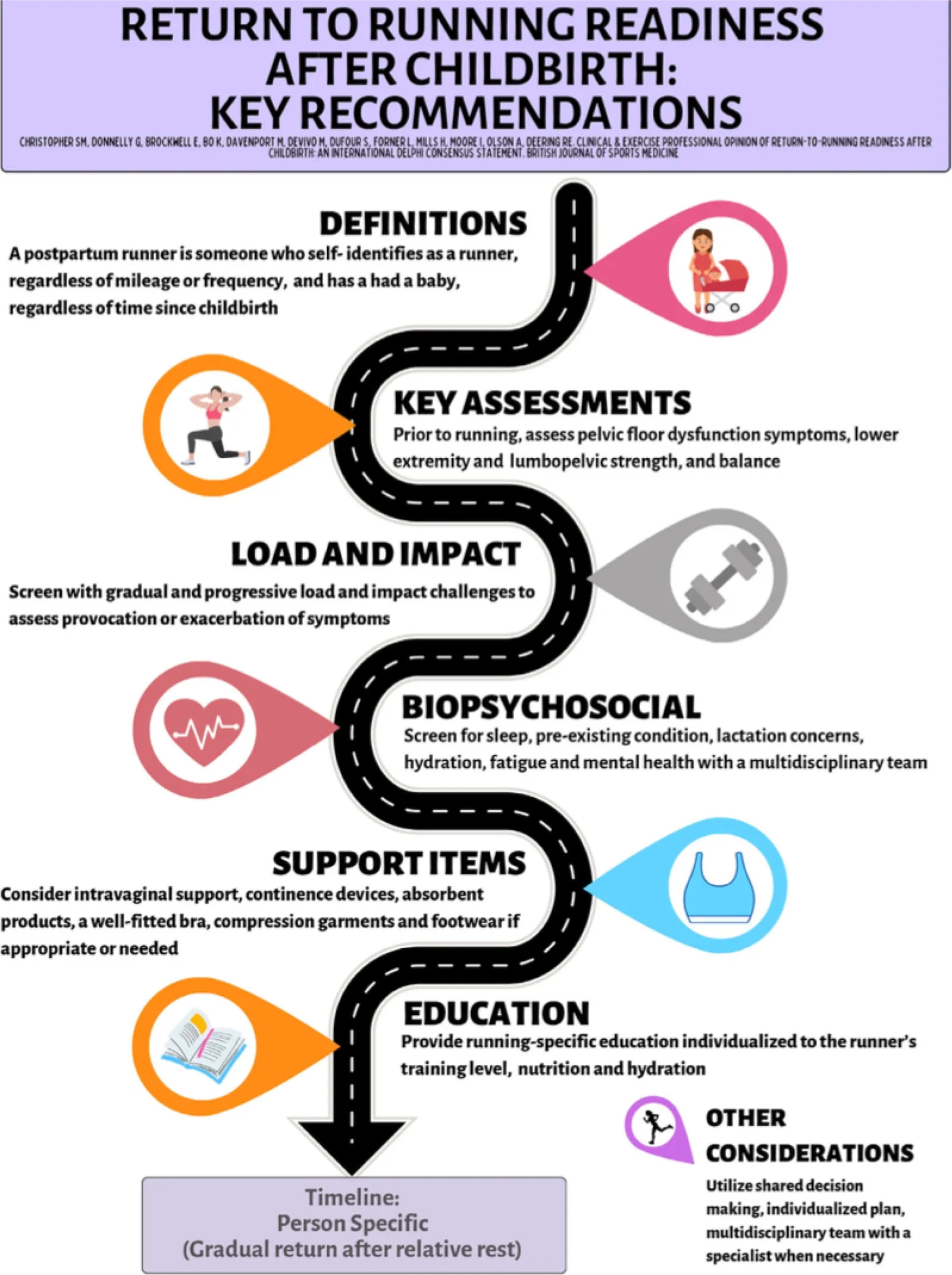
Beyond that, the question in this situation is often when normal (abdominal) training can take place again and when it can't. Which exercises are OK? Can you go jogging, or when can you start again? To answer these questions, various individual studies were consulted. A survey by Prevett et al. (2022) asked whether heavy strength training during pregnancy (80% 1RM) led to more problems. The case numbers for, e.g., depression or gestational diabetes were lower here than in the average population. A consensus paper by Christopher et al. (2024) with 118 experts concluded that a return to jogging after birth should be tied to the following criteria: at least 3-4 weeks of rest after birth, individual planning, consideration of the bone situation, the mental situation and the pelvic floor and abdominal muscles with regard to their coordination and strength, exclusion of any incontinence, and completed wound healing if an injury occurred during birth. Furthermore, lower-body strength should have improved again, and balance/proprioception should be back to the normal level from before pregnancy. Possible test exercises in this area could be: walking for 30 min, single-leg stand for 10 sec., jogging on the spot for 1 min., 10 (horizontal) jumps, 20 reps of calf raises or 20 reps of the single-leg hip bridge. The necessary general education should also have taken place, and if needed, various aids/equipment can be used (compression, special sports bras, suitable shoes etc.).
Training the abdominal muscles
Regarding training of the abdominal muscles, no precise recommendations could be derived from the reviews by Gluppe et al. (2021) and Skoura et al. (2024). However, various exercises/training methods (curl-ups, eccentric training, pelvic floor training, breathing exercises) can help reduce rectus diastasis and are therefore recommended as preparation for subsequent daily tasks, and they are also classified as safe. Both deep and superficial muscles may – and should – be targeted. Coordination training of these muscles is therefore also important.
Conclusion: In summary, training of strength and endurance should always be recommended for women without contraindications, as it has various positive effects for mother and child. Training should always be geared to the current state and can be monitored, for example, with the BORG scale or a rate of perceived exertion tool. If you have questions, you should talk to a specialist physician or a pelvic floor specialist.
"All women without contraindications should be encouraged to participate in aerobic and strength-conditioning exercises as part of a healthy lifestyle during their pregnancy and after that as well."
Sources
[1] Kader M, Naim-Shuchana S. Physical activity and exercise during pregnancy. Eur J Physiother 2014; 16(1): 2-9.
[2] Mudd L, Owe K, Mottola M, et al. Health Benefits of Physical Activity during Pregnancy: An International Perspective. Med Sci Sports Exerc 2013; 45(2): 268-77.
[3] Nascimento S, Surita F, Cecatti J. Physical exercise during pregnancy: a systematic review. Curr Opin Obstet Gynecol 2012; 24(6): 387-94.
[4] Downs D, Chasan-Taber L, Evenson K, Leiferman J, Yeo S. Physical Activity and Pregnancy: Past and Present Evidence and Future Recommendations. Res Q Exerc Sport 2012; 83(4): 485-502.
[5] Lewis B, Avery M, Jennings E, et al. The effect of exercise during pregnancy on maternal outcomes: practical implications for practice. Am J Lifestyle Med 2008; 2(5): 441-55.
[6] Pivarnik J, Chambliss H, Clapp J, et al. Impact of Physical Activity during Pregnancy and Postpartum on Chronic Disease Risk. Med Sci Sports Exerc 2006; 38(5): 989-1006.
[7] Szumilewicz, Anna & Worska, Aneta & Rajkowska, Natalia & Santos-Rocha, Rita. (2015). Summary of Guidelines for Exercise in Pregnancy–are they Comprehensive Enough for Designing the Contents of a Prenatal Exercise Program?. Current Women's Health Reviews. 11. 10.2174/157340481101150914200838.
[8] Gaston A, Vamos C. Leisure-Time Physical Activity Patterns and Correlates Among Pregnant Women in Ontario, Canada. Maternal & Child Health J 2013; 17(3): 477-84.
[9] Juhl M, Madsen M, Andersen A. Distribution and predictors of exercise habits among pregnant women in the Danish National Birth Cohort. Scan J Med Sci Sport 2012; 22(1): 128-38.
[10] Wojtyła A, Kapka-Skrzypczak L, Paprzycki P. et al. Epidemiological studies in Poland on effect of physical activity of pregnant women on the health of offspring and future generations - adaptation of the hypothesis development origin of health and diseases. Ann Agric Environ Med 2012; 19(2): 315-26.
[11] Liu J, Blair S, Teng Y. et al. Physical activity during pregnancy in a prospective cohort of British women: results from the Avon longitudinal study of parents and children. Eur J Epidemiol 2011; 26(3): 237-47.
[12] Owe K, Nystad W, Bo K. Correlates of regular exercise during pregnancy: the Norwegian Mother and Child Cohort Study. Scan J Med Sci Sport 2009; 19(5): 637-45.
[13] Petersen A, Leet T, Brwonson R. Correlates of Physical Activity among Pregnant Women in the United States. Med Sci Sports Exerc 2005; 37(10): 1748-53.
[14] Evenson K, Savitz D, Huston S. Leisure-time physical activity among pregnant women in the US. Paediatric & Perinatal Epidemiology 2004; 18(6): 400-7
[15] Dipietro L, Evenson KR, Bloodgood B, et al; 2018 PHYSICAL ACTIVITY GUIDELINES ADVISORY COMMITTEE. Benefits of physical activity during pregnancy and postpartum: an umbrella review. Med Sci Sports Exerc. 2019;51(6):1292-1302.
[16] Cremona A, O’Gorman C, Cotter A, Saunders J, Donnelly A. Effect of exercise modality on markers of insulin sensitivity and blood glucose control in pregnancies complicated with gestational diabetes mellitus: a systematic review. Obes Sci Pract. 2018;4(5):455-467.
[17] Mottola MF, Davenport MH, Ruchat SM, et al. 2019 Canadian guideline for physical activity throughout pregnancy. Br J Sports Med. 2018;52(21):1339-1346.
[18] Physical activity and exercise during pregnancy and the postpartum period: ACOG committee opinion, number 804. Obstet Gynecol. 2020;135(4):e178-e188.
[19] US Department of Health and Human Services. Physical Activity Guidelines for Americans. 2nd ed. US Department of Health and Human Services; 2018. Accessed October 27, 2020. https://snaped.fns.usda.gov/library/materials/physical-activityguidelines-americans-2nd-edition
[20] Yang, X., Li, H., Zhao, Q., Han, R., Xiang, Z., & Gao, L. (2022). Clinical Practice Guidelines That Address Physical Activity and Exercise During Pregnancy: A Systematic Review. Journal of midwifery & women's health, 67(1), 53–68. https://doi.org/10.1111/jmwh.13286
[21] Christopher, S. M., Donnelly, G., Brockwell, E., Bo, K., Davenport, M. H., De Vivo, M., Dufour, S., Forner, L., Mills, H., Moore, I. S., Olson, A., & Deering, R. E. (2024). Clinical and exercise professional opinion of return-to-running readiness after childbirth: an international Delphi study and consensus statement. British journal of sports medicine, 58(6), 299–312. https://doi.org/10.1136/bjsports-2023-107489
[22] Prevett, C., Kimber, M. L., Forner, L., de Vivo, M., & Davenport, M. H. (2023). Impact of heavy resistance training on pregnancy and postpartum health outcomes. International urogynecology journal, 34(2), 405–411. https://doi.org/10.1007/s00192-022-05393-1
[23] Skaug, K. L., Engh, M. E., Frawley, H., & Bø, K. (2022). Prevalence of Pelvic Floor Dysfunction, Bother, and Risk Factors and Knowledge of the Pelvic Floor Muscles in Norwegian Male and Female Powerlifters and Olympic Weightlifters. Journal of strength and conditioning research, 36(10), 2800–2807. https://doi.org/10.1519/JSC.0000000000003919
[24] Skaug, K. L., Engh, M. E., & Bø, K. (2024). Pelvic floor muscle training in female functional fitness exercisers: an assessor-blinded randomised controlled trial. British journal of sports medicine, 58(9), 486–493. https://doi.org/10.1136/bjsports-2023-107365
[25] Carlstedt, A., Bringman, S., Egberth, M., Emanuelsson, P., Olsson, A., Petersson, U., Pålstedt, J., Sandblom, G., Sjödahl, R., Stark, B., Strigård, K., Tall, J., & Theodorsson, E. (2021). Management of diastasis of the rectus abdominis muscles: recommendations for swedish national guidelines. Scandinavian journal of surgery : SJS : official organ for the Finnish Surgical Society and the Scandinavian Surgical Society, 110(3), 452–459. https://doi.org/10.1177/1457496920961000
[26] Kramer MS, McDonald SW. Aerobic exercise for women during pregnancy. Cochrane Database of Systematic Reviews 2006, Issue 3. Art. No.: CD000180. DOI: 10.1002/14651858.CD000180.pub2.
[27] Brown J, Ceysens G, Boulvain M. Exercise for pregnant women with gestational diabetes for improving maternal and fetal outcomes. Cochrane Database of Systematic Reviews 2017, Issue 6. Art. No.: CD012202. DOI: 10.1002/14651858.CD012202.pub2.
[28] Gluppe, S., Engh, M. E., & Bø, K. (2021). What is the evidence for abdominal and pelvic floor muscle training to treat diastasis recti abdominis postpartum? A systematic review with meta-analysis. Brazilian journal of physical therapy, 25(6), 664–675. https://doi.org/10.1016/j.bjpt.2021.06.006
[29] Skoura, A., Billis, E., Papanikolaou, D. T., Xergia, S., Tsarbou, C., Tsekoura, M., Kortianou, E., & Maroulis, I. (2024). Diastasis Recti Abdominis Rehabilitation in the Postpartum Period: A Scoping Review of Current Clinical Practice. International urogynecology journal, 35(3), 491–520. https://doi.org/10.1007/s00192-024-05727-1
[30] Theodorsen, N. M., Bø, K., Fersum, K. V., Haukenes, I., & Moe-Nilssen, R. (2024). Pregnant women may exercise both abdominal and pelvic floor muscles during pregnancy without increasing the diastasis recti abdominis: a randomised trial. Journal of physiotherapy, 70(2), 142–148. https://doi.org/10.1016/j.jphys.2024.02.002
[31] Rise, E., Bø, K., & Nystad, W. (2019). Is there any association between abdominal strength training before and during pregnancy and delivery outcome? The Norwegian Mother and Child Cohort Study. Brazilian journal of physical therapy, 23(2), 108–115. https://doi.org/10.1016/j.bjpt.2018.06.006
[32] Laframboise, F. C., Schlaff, R. A., & Baruth, M. (2021). Postpartum Exercise Intervention Targeting Diastasis Recti Abdominis. International journal of exercise science, 14(3), 400–409.